More uncertainty over the AI boom, the outlook for Wall Street and elections could reshape the US markets. While global equity markets remain uncertain, where are the opportunities? Well, to understand how he's reading the global markets and what it means for Indian investors, let's go straight to renowned investor and philanthropist Mr. Monish Pabrai. Well, Monish, it's good to have you on the show. It's been a while since we caught up and glad to have you after a few years on the show. >> Nigel, it's great to be back here and the festive season is around the corner and hope you have wonderful set of holidays. >> Well, wishing you and your family as well a very, very happy festive season, Monish. I know your heart's always in India, though you sit out of the United States. >> Absolutely. >> All right, Monish, let's get straight then to talking about equities. And let's talk about the mother market, the US market that is. It's remained very, very resilient, right? Despite those inflation concerns, the elevated bond yields as well. And there's surprisingly little talk of any US slowdown or even a recession. Do you believe that the American economy is strong enough? And do you think that the bears out there, you know, they're actually being sidelined for the time being, but they could show up, particularly in the US markets that have been extremely resilient. >> I would just say, Nigel, that we don't have any other country in the world like the US. It's a very unique place. It's a wonderful place. It definitely has its problems, but just just in terms of the economic engines and the innovations and you know, the Elon's of the world and all of that. There's a lot of tailwinds. But at the same time, when we look at it investing markets point of view, we have some let's say weird lopsidedness going on in the US currently as well. >> As you said, the US markets have done well. They've been quite resilient. The economy seems to be in pretty good shape as well. But where do you place with regard to this AI trade? >> Just to give you one data point that you might might find interesting is the S&P 500, the value of the entire S&P 500 all 500 companies 16 years ago 2010 was about $10 trillion. And today, the top two companies, Nvidia and Apple, are over 10 trillion. So, you have a massive kind of skewing of how this kind of value has changed in the last 16 years. And I think it's changed in a very extreme manner. So, you know, markets go through ups and downs and periods of euphoria and periods of depression, etc. On the AI side, I think the men will get separated from the boys eventually. >> Manish, with the US midterm elections, they're approaching. How much could the political outcome matter for global equities? And what are the odds of Mr. Trump coming out on top? >> Well, I mean, I think my best guess is the midterms are not going to end up making a lot of change because, you know, these are all individual races in different places and it's not all decided based on whether people like or don't like President Trump. >> So, you know, if I were to break it down, I think you managed to close around a billion and a half dollars with Adaptec. But Turkey accounts for more than 60% or 55-60% of your portfolio. And despite its high inflation, you know, it has its own set of currency challenges as well. What makes the investment in Turkey, you know, which is not something we hear about very often, so compelling for you? >> What I noticed about 8 years ago, 2018 was when I first started looking at Turkey. It was screening as uh probably the cheapest market in the world. And so, I was just curious to kind of kick the tires a little bit. And I have a good friend in Istanbul, one of the largest fund managers in the country. And so, I I said, "Look, I'd like to visit and I'd like to visit the companies in your portfolio if you'd be okay with that." And he was very excited to do that. So, I made my first trip in 2018, and it was a big eye-opener. So, exactly what I had been seeing kind of on paper, when I started meeting the individual companies, looking at kind of what the valuations were and what the prospects of those businesses were, it was truly extremely lopsided. And Turkey has very high inflation. It had a very unstable currency. But, I was able to look at businesses where those factors become irrelevant. And when I looked at uh businesses where inflation was irrelevant or the currency was irrelevant, the market had given up on everything. And so, valuations were very extreme. And just to put it in context, I mean, I was picking up assets worth a dollar for 2 or 3 cents, you know, 3%, 4% of liquidation value. It was just widely, widely mispriced. The other unusual thing about the Turkish market that I noticed, which is very different from the Indian market, is almost the entire market, the retail participants as well as even the institutions, are extremely short-term oriented. The float of the average Turkish public company cycles every 17 days. It's like kind of looking at a company in India, like let's say Reliance or Titan or something, and and looking at the uh free float and seeing trading volumes like that. We don't see anything like that in India. We don't have that type of short-term measure. And Buffett has a quote. He said, "The market is a mechanism to transfer wealth from the active inactive." And so, if you take a buy and hold approach anywhere in the world and you hold great businesses, uh you're going to do very well. In Turkey, almost no one is doing fundamental analysis. So, when I look at a place like India and I look at maybe there's 100 or 200 great investable business in India. >> Mhm. >> They are very picked over. They're very smart investors in India. They bid them up in price. I mean, if you look at business like D-Mart for example, wonderful wonderful business. No returns to the equity holders for the last 6 or 7 years. Not because the business is not doing well. It's because it was bid up so much in price because people loved it so much. Asian Paints, same situation. Tata Consultancy Services, same situation. So, and you know, you're you're more familiar with this, Nigel, that last few years, the Indian markets haven't delivered. They have not delivered not because the companies aren't great. >> Uh-huh. >> There are some very, very good businesses in India. It's that those businesses were bid up to prices >> Mhm. >> which made no sense. Just like in the US, if you were to invest today into Nvidia or into Apple or into TSMC in Taiwan, I don't think you'll be looking at great results 10 years from now. >> Take us a little bit through you know, that investment thesis in Turkey and we'll close the loop on Turkey post this. Your investment in Reysaş, you know, that's an investment that's delivered extremely good and solid exceptional returns for you. Uh the thought process while making that investment >> say yeah, so I think if you look at a company like Reysaş, which is a REIT, you know, we have several REITs in India that are publicly traded. Reysaş was a company that 7 years ago, when I first invested, the market cap was less than 20 million US dollars. Liquidation value was about 800 million. So, it was trading at like less than 3% of what it was worth. Just crazy numbers. And the trading volumes were very high. So, for 8 million dollars, we were able to buy 1/3 of the company. And Turkey does not, unlike India, it does not impose restrictions on how much of a company a foreign investor can own. Today, 7 years later, we own more than 42 and a half percent of Rasa's and the market cap is over 2 billion. So it's gone up 100 x in dollar terms in lira terms is gone up infinite but who cares about that and it's still undervalued. So liquidation value that used to be 800 million 7 years ago is over 3 billion and what I did not realize when I was buying the business 7 years ago was I did not understand how good the management was how good the promoters were. I just thought okay this company you know it's kind of like buying something worth a million dollars for 20 or 30,000. They are compounding the business the way Titan is compounding the way Dmart is compounding but it's like buying a Titan or buying a Dmart at a P of three or four you know we don't have that opportunity currently in India. You know my hero Charlie Munger has a quote that take a simple idea and take it seriously. So when I looked at Turkey and I saw this dynamic of the short-term traders that no one is looking at these businesses they were a solid 70-80 businesses in Turkey that have good governance. So I just went through that that list and picked the highest quality businesses I could find. >> Well Monish as promised let's get straight to India. I think you have less than 2% of your portfolio in India. What is that a reflection of? Expensive valuations, shortage of opportunities or simply the fact that you're finding better opportunities elsewhere? >> In the past we've had 40-50% of our portfolio in India at times. When I look at the opportunities in India opportunities that some of the other places that we we compared to I think the the the issue is that India has some really good businesses which have great prospects and will do really well in the future. The issue is that it also has some very smart investors who have figured that out and have priced those businesses to perfection. So usually when I encounter or find a great business in India I will usually find that it is either fully priced or more often overpriced. You know, we have more than 5,000 listed companies in the Indian exchanges, the NSE and Bombay Stock Exchange, and maybe 100 or 200 of them have great governance, great business models, great management. So, that's really the investable universe from my point of view. Those 100 or 200 businesses are very well known, very well liked, and bid up too much in price in my opinion. Then for me, someone like me sitting so far away from India, my ability to find diamond in the rough, a 100 bagger, a potential 100 bagger, is much more difficult in a place like India than even the US or for that matter Turkey or several other geographies. So, there was a time There have been many times in the past where India has been tremendous value. And today India is better value than it was two or three years ago. Valuations have come down, and there have been some adjustment, but they have not adjusted to the level that it entices someone like me, but I keep watching, and it might become an interesting place in the next few years. We'll see. >> All right. Monish, you know, you would be speaking to a lot of global investors as well. You know, and India has not been top of the pops with regard to the foreign inflows. What do you think, you know, what would get that attraction back for the Indian markets? Would it be lower valuations? Would it be a correction in crude oil prices? Or more importantly, how big an issue is taxation? >> Yeah, I think I think India has some of the best business leaders and best entrepreneurs in the world. You know the joke about the economy grows at night when the government sleeps. So, India does not do well because of the laws and rules and taxes and government. It does well in spite of it. There's a lot of things that a lot of Indian entrepreneurs have their hands tied behind their back, they still do really well. So, I think one of the big positives for India is tremendous entrepreneurial energy, tremendous management prowess, and a great market, and also great export prospects. So, all of those things are tremendous for India. I also feel that investors in India, you know, they have the opportunity with LRS and all of that to invest outside the country. And I think that when we look at how Indian families have historically invested, they have moved into the equity markets, which is really good. That's wonderful to have that exposure. But I think that they would be well served to look at equity markets outside India as well. Because there are a lot of great assets in different places that getting exposure to those would be a net positive for those families. >> Maneesh, let's get back to you know, you you have you know, mentioned in passing that India could provide an opportunity. Some of those listed companies, some of those companies out here, well, they could do well. Are there any of them that are actually studying here in India? Because in the past, you know, you have taken concentrated bets and it's been very very good returns for you, whether you look at the real estate investments that you've made or probably the CPC maker here in India as well. But are there a couple of investment ideas that you have on your radar here in India that are catching your attention? >> Currently, I don't have much that is I mean, we have a couple of positions in India. One is Edelweiss, which I think next week is going to spin out EEE. There's an IPO coming I think next week for EEE. And that looks interesting because I think company that they're going to spin out is going to have a higher market cap than the parent. So, there is a bit of mispricing there, which is interesting for us. And I like I like that business because they've got other IPOs that will be coming out, you know, their mutual fund business and some other business and insurance and so on that they'll spin out. I think that in general the financial services sector in India, even though it's gone through a lot of growth, extremely embryonic. I mean, we used to have a very very small investor base relative to the population of the country, which has gone up in the last 7-8 years, but compared to where that will be in the next 10 or 20 years. It's still very embryonic. So, that is the big positive about India is there is a lot of runway ahead. And if we can identify some businesses with reasonable valuations who can take advantage of those runways, it can work out very well. >> Okay, uh well, before we wind this down, Monish, uh let's get a couple of factors out of the way. US markets on fire. Do you think uh there's a probability that that cools off a little bit? And also, if you could quickly comment on some of those Asian peers, KOSPI and Taiwan, well, they have been going gangbusters this year. Uh any comment on those markets? Why didn't they catch your attention? >> Yeah, so I would say that the US markets, the if you look at the index, the S&P 500, for example, it's not going to be a good place to be for the next 10 years. I would say that the returns on average every year for the next 10 years for the S&P 500 will be between plus 2% a year and minus 2% a year, basically flat. So, it's not going to go very well. When we look at markets like Korea, the KOSPI, for example, it's really a memory story, you know, Samsung and SK Hynix. And in general, in a gold rush, you want to own the companies making the pickaxes. So, if there are any businesses in the AI sector that will likely long-term do well, it will be Nvidias of the world and the memory guys like Micron and the TSMCs of the world. All of them have to go with that. So, one thing we have to keep in mind is that the amount of spending that's going on in AI, you know, you hear these numbers, this company is going to spend 100 billion, 300 billion, 500 billion. What they are getting for that money and what they would have gotten for that money 5 years ago is a five to one difference. There's been massive inflation. They are basically funding the memory guys, all going into the profit of the memory guys at 80-90% margins, the TSMCs of the world, the Nvidias of the world. So, basically, AI software companies are paying through the nose for uh things that were valued at 1/5 of where they valued today. So, we have a lot of inflation in the spending taking place. So, the place to look at is where that money is going. And so, I think the tool makers, the pickaxe makers are likely to do well in that equation. But, I also feel that if one fully sidestep uh the AI bet, we have for example no AI bets. And because we just gone to areas of the markets that people have no interest in, and we found tremendous value there. And that's where I like to be. That's wonderful. >> Well, Monish, it's always a pleasure having you on the show. Thanks a lot for joining in, giving us your investment thesis, and how you place globally. We got that point that Turkey is the top investment bet for you. With regard to the companies out there, US comes in second place, and India not so much exposure at least as of now. We appreciate you joining in, and look forward to chatting up with you rather soon. Thanks a lot for joining in. >> Always a pleasure, Nigel.


 Nikko MontanezHandmade chocolate business idea 💡 #shorts #trending #businessidea
 Predictive HistoryGame Theory #1: The Dating Game
 The Daily BeastWhy Billions Won’t Save Trump from Crushing Defeat | Inside Trump's Head
 Einfach MedizinEmbryologie - Befruchtung und Implantation einfach erklärt
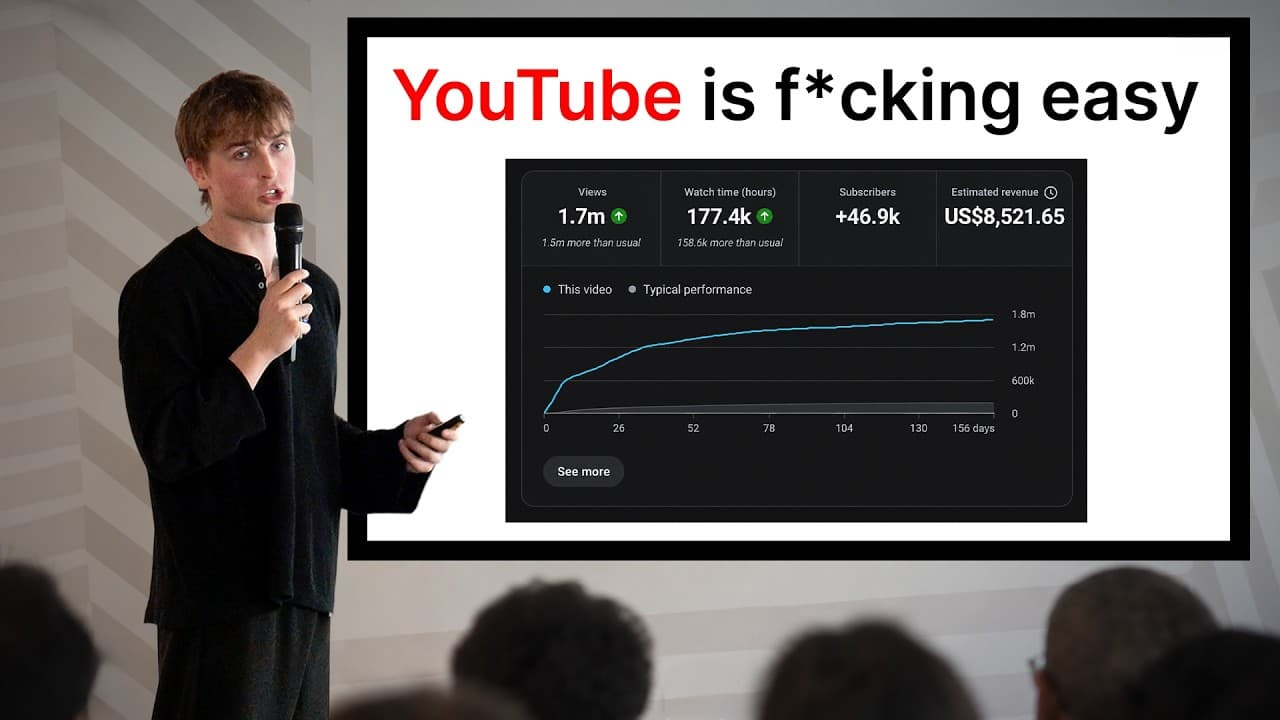 Jake TrinderThe Most Valuable YouTube Training You'll Ever Watch