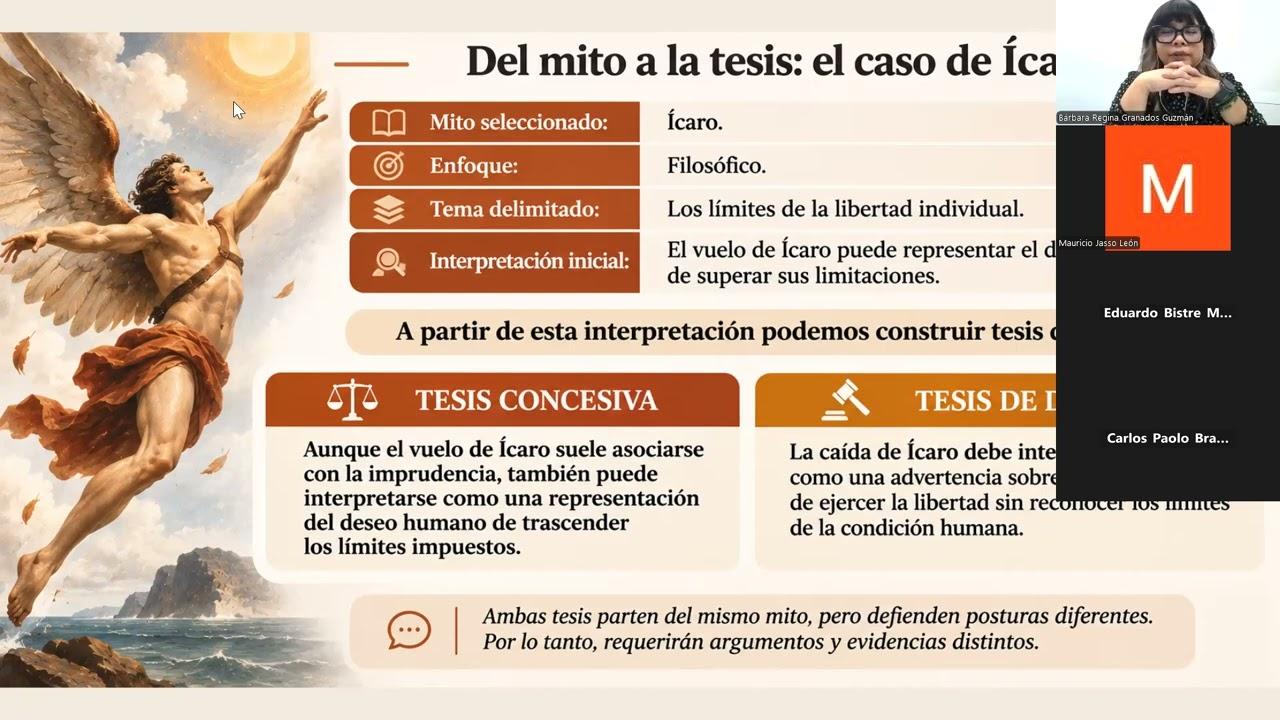
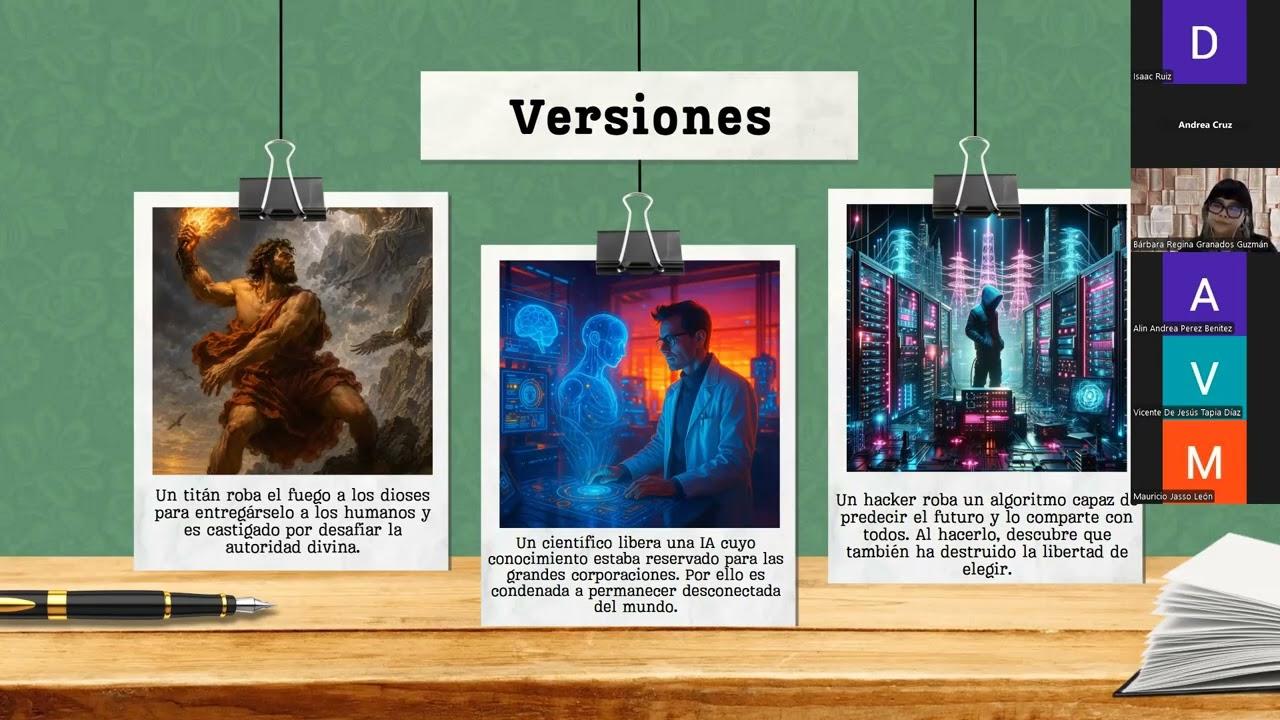
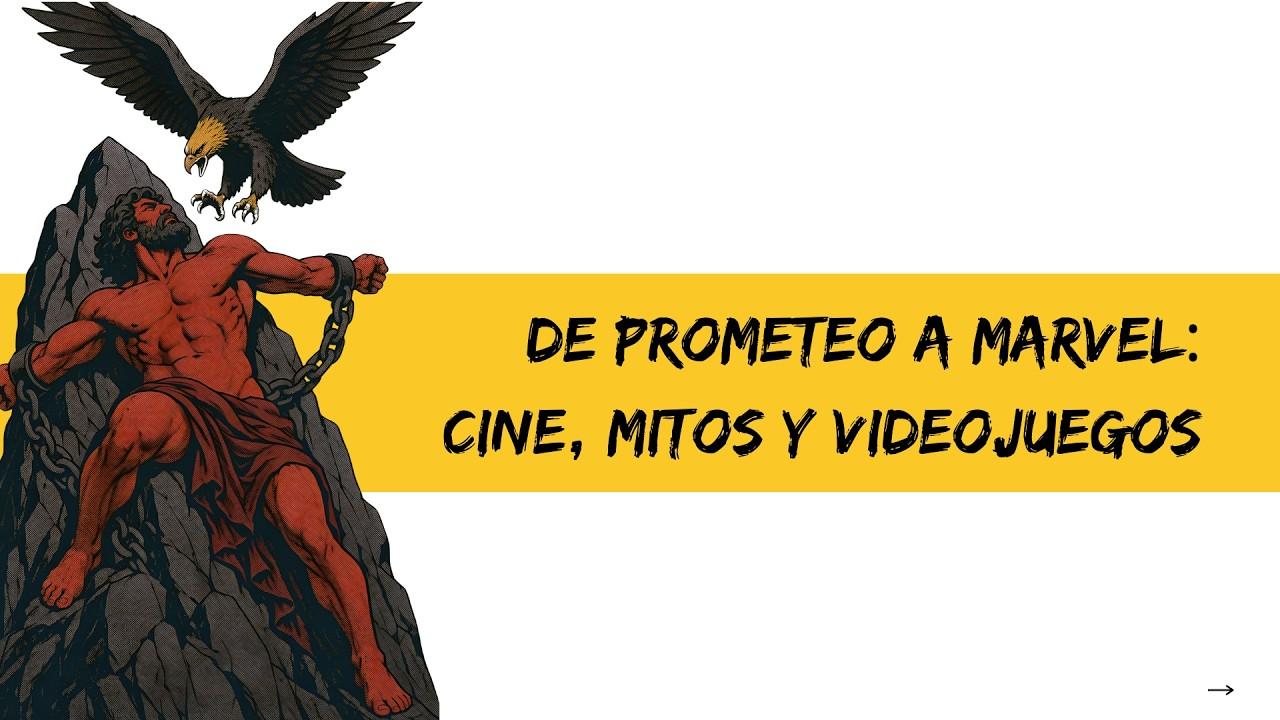
Uh, but based on this week's work, with the class we had last week, the class on Monday, this week's homework, and what we're going to see today, we're already getting ready to start working fully on evidence. Evidence one is due next Sunday. So, this class and the following ones are going to focus on developing issues , parts, and elements that will help us build that evidence, right? And today we're going to work on a topic that's very pertinent because it talks about myth and interpretation, right? What do I mean by myth and interpretation? When we approach a text, a reading, or a book—let us say a myth, a short story, a novel, or a historical account—we are always receiving the message that is contained within it; That is to say, we receive what is meant to be said in the words we are reading. But we also have a framework of interpretation, that is to say, a framework in which we, with our experience, with our understanding, with what we know about the text itself or other knowledge, go into forming an interpretation and a meaning of what we are reading, right? This also happens a lot in oral communication. When suddenly someone is telling you something and you begin to understand a message, right? If the tone in which they tell me it is serious, well, I might interpret that they may be upset, that they may be upset, that they may be unwilling to talk about that topic, etc., etc., right ? So, that interpretation that happens with the messages we receive from communication in our, that is, in our day-to-day lives, in our conversations, also happens when we approach texts, when we approach articles, news, novels , X X written material, right? Myths, of course, are no exception, but when we talk about constructing academic or formal interpretations, well, there are certain guidelines and certain aspects that we have to take into account in order to give them a more concrete, more direct meaning to those interpretations, right? So, that's exactly what we're going to do today, right? We're going to talk a little bit about the interpretation of myth, right? What does it mean to interpret a mythical narrative, right? Well, of course, interpretation consists of attributing a well-founded meaning to the elements of a narrative, right? The elements that compose it, that build it, that are told to us through the written words that make up these mythical narratives, right? It's not about inventing arbitrary meanings, but about establishing relationships between events, symbols, characters, cultural contexts, and human concerns. We can analyze the same myth from different perspectives without there necessarily being a single correct reading, right? And that's why yesterday I asked you in our WhatsApp chat to read or watch a video about the myth of Prometheus so that you could have a fresh idea, because this is one of the most diplomatic examples and, well, the course is called From Prometheus to Marvel, right? So, we have used this mythical narrative quite a lot, there is so much to analyze , and we are going to use this specific narrative structure to explain today's topic, wouldn't you agree? That's why I asked you to read it so that it's fresh in your mind and that all these explanations and all these relationships that we're going to make today make more sense, right? So, in this initial approach that we are currently making at this moment to this myth, we have these three distinct representations before us, don't we? Prometheus as a liberator, right? Prometheus as a solitary, right? Acting in an act of freedom, right? Then we have Prometheus punished, that is, Prometheus already suffering the consequences of his decisions, and then we have Prometheus who gives fire to humanity, right? As a good act, as an act of liberation, as an act of giving to others that which they truly need in order to develop and in order to survive. So, these three interpretations are made of the same myth, but taking its components, its symbols, its characters and its contexts, interpreting them from different points of view, but they are all valid because all these interpretations are going to land on the fact that there is a specific explanation and there are elements within the narrative from which these interpretations can be derived. In other words, that is why it is mentioned that it is not about inventing meanings, right? Saying, well, I am going to take this position that I am going to portray Prometheus as a dictator, right? Well, there are no elements in the mythical narrative that tell me that Prometheus can be interpreted as a dictator, right? He can be interpreted in many other ways , but not as a dictator. So, that is where the line is found where the interpretation is logical, it is coherent and when it is, well, a question that has no basis for arguments , right? That is precisely where we are going to delve a little deeper into today's topic . Interpreting a myth, young people, ex-huh, then, involves examining how the characters that make up its narrative, the events, the symbols, and the conflicts can express ideas that transcend the narrative. In other words, they transcend the narrative, meaning that we can continue their interpretation beyond what is told to us in the text. In other words, they have a deeper meaning than I could, specifically from those lines that the narrative is giving me, to continue developing an idea, but starting from a base that exists, right ? That is there, that is real, that is within the mythical narrative, right? We have three levels of approach, and each of these levels gives us a possibility, right? Number one is literal understanding. What do we identify? What happens? Who participates? How does the conflict develop? And the specific question here is, what does the myth tell us? I mean, what is it trying to say? What will allow us, let's say, the cognitive action that will allow us literal understanding is to know the story. I mean, reading it, I've already gotten to know it, I've seen what it has to say to me and let's say that I stay at that level of okay, I already know what it says, I already know what it is, I already know what the myth of Prometheus says, but I don't delve into its meanings, its symbolisms , etc., etc., right? It's just how I know it and that's it. Then we have a deeper level which is interpretation, which is what we are at the first level, well, more like the level because the first one is reading, but it's the next stage when we start to analyze and begin to unravel the meanings of a story, right? When we begin to appropriate the message , we try to begin to understand it and to try to begin to understand it, because it is one thing to know about it , to read it, to know that it exists, to know what it says, and another to understand and comprehend what it is transmitting to me, what is the message , what is the metaphor, what is the symbolism that the text is transmitting to me, right? So interpretation is, let's say, the first cognitive level to begin to appropriate the ideas of a text, a meaning, right? So at this level of interpretation, which is the second level of approximation, we explore the meanings that the events, symbols, and relationships that occur within the story may have, right? The question is what could happen, that is, these facts that are being narrated to me, mean, what could they be translated into, right? And let's say that the cognitive action that will allow interpretation is precisely exploring the meanings, exploring the different interpretations that we can have about a myth, right? Or any text, right? Right now we are talking about myths because this is what concerns us both in the subject and in the work, we are going to be working precisely on the interpretation of a myth and on the creation of a thesis and on the creation of arguments, etc., etc. Right now we are going to explain the evidence, right? Then we have the critical problematization where we already make a criterion, a position, when we take part of what happens in the text, right? For example, in the interpretation, oh, excuse me, because my eye is itching. In the interpretation, we start by trying to understand it, but in the critical problematization, we already find a problem or a tension or an issue that has to do with the development of elements that can create tension in the interpretation, right? I mean, when you start to see contradictions or opposing elements or situations that you probably know can generate other more complex situations, well, that's what critical problematization is, right? Identifying tensions, contradictions, alternative interpretations that allow you to develop your own position. In other words, how am I going to feel about the myth of Prometheus? For me, which of the interpretations is going to be the one I'm going to stick with, right? I mean, because for example, we can understand that perhaps the myth of Prometheus can be explained to show the consequences of disobeying divine orders , right? But perhaps for me, because of how I interpret it and because of my personal context, that doesn't resonate with me as the heart of the myth, right? Perhaps I see Prometheus as a liberating figure, as a figure who allowed fire to be given, allowed the advancement of knowledge and the advancement and development of society. And it is with this problematization that I, in my opinion, want to take that position, right? So, for me, Prometheus is going to be a liberator beyond a person who deserved to be punished for breaking a divine order, right? So, taking a position is always accompanied by a problematization. We need to understand or see a problem, see a tension, see a contradiction in order to decide on which side of the text, on which interpretation we are going to place ourselves with a critical stance, right? So, observe how each of these elements serves to delve more deeply into the specific way in which we approach the study of mythology, right? In general, when it comes to understanding these narratives that always carry metaphors, symbolism, morals, and reflections, those elements that make you reflect on humanity, on power, on divinity, on the order of the constructed universe, and so on and so forth, do they not? So, since these are narratives that have to do with those fantastic or primordial elements such as the origin of the universe, the origin of things, the natural order, power, tensions that have to do with the divine, the sacred, the profane, etc., etc., well, it does imply that we enter into this context, into these mechanisms of not only reading it to know what it tells us, but also interpreting it and then finally, critically problematizing it, right? Are there any questions so far, guys and girls? You can give me a like to know that we are understanding it well. Also, to know that you are awake, so that this development is not overwhelming. Okay, thank you very much. Okay. Let's continue. So, speaking precisely of the different interpretations of the myth of Prometheus, well, we have these...How many are there? Five, five ways of interpreting it, right? We have Prometheus as a benefactor, whose attributed meaning is a question of his action, representing the delivery of resources that benefit humanity. The question we could ask ourselves about this meaning is, is it legitimate to transgress a norm to benefit others? Right? In other words, does the common good justify disobedience, right? It's a way of approaching the same facts , but each of these is going to have a different position. Anyone who wants to read Prometheus as a transgressor and help me with what I need? Alexa, go ahead, thank you very much. >> Prometheus as a benefactor >> As a transgressor. >> Oh, sorry. >> The second one, yes. >> His defiance questions the limits imposed by authority and the question that all disobedience poses is a threat to order. >> Mhm. Very good, thank you very much. At this very point, we have another position that is based on the same facts , do we not? His defiance questions the limits imposed by authority, which is why he is transgressive. And so these questions that we can raise are the ones that can lead us to develop a position, right? Does all disobedience represent a threat to order? It doesn't seem like that to me, so for me Prometheus is going to be a transgressive figure, right? Then we have Prometheus as a symbol of knowledge where fire is not just an element, right? It represents the technical and transformative capacities of the human being. Here, the question is, does knowledge necessarily lead to progress? In other words, was that fire necessary to develop a chain that would ultimately end in the development of knowledge and the progress of society, right? It's like a chain of interpretations that we make in order to build these positions, right? Then we have Prometheus as a figure of sacrifice. His punishment represents the consequences of defying power. And the question is, what is the price of acting according to our convictions? Why does Prometheus act in that way? Why does he decide to defy the direct divine order not to share the fire? So, what is the price of acting according to our convictions? That is the question that generates the interpretation that Prometheus sacrifices himself, because he decides to ignore the consequences and then face the individual consequences, but let's say that in this interpretation we can think that it doesn't matter, right? It doesn't matter because ultimately his punishment is something that allowed for a greater good, a common good, right? Which is precisely what is linked a bit to Prometheus as a benefactor. Then we have Prometheus as a technological metaphor. His story allows us to reflect on the power of innovation . Should there be any limits to technological development? This is already more stretched, right? If you notice, the first four are very obvious, very logical, and the last one would be something like, well, I want to maybe include a deeper meaning, something that has to do with the development of innovation. Okay, innovation, fire, development of the industry, and then you start linking it to justify it, right? But it feels a little more tense. On a personal level, how do you interpret Prometheus? Which of these interpretations makes more sense to you or do you prefer, let's say, as a reflection, as a position on the mythical story of Prometheus? Benefactor, transgressor, like fire as a symbol of knowledge, as a figure of sacrifice. Tell me. Go ahead, Pablo. >> Oh, sorry. For me, I see Prometheus as a symbol of knowledge. >> Mhm. >> And well, the truth is, yes, I mean, the truth is that I see it as an act, not very...Ah, the word went out, but not selfish. >> Mhm. >> And that basically, thanks to that, sacrifices must be made for the advancement of all. >> Mhm. >> In a few words. >> Very good. >> Yes. >> And that is the position that you take regarding the myth, right? I mean, how do you interpret it and, let's say, the way in which it makes sense to you, right? If I, perhaps, try to convince you to see Prometheus as a benefactor, it might not have the same meaning for you; because for what, let's say, resonates with you is a question of the development of knowledge, and that is precisely the way in which we reflect our positions. Thank you very much, Pablo. Does anyone identify with any other element and want to share with us a different point of view? Anyone who sees it, for example, as a benefactor? Or someone else? Express yourselves. Go ahead, Pablo. I cleared up your >> doubts. I don't know if you'll answer any questions we ask you about the project. >> Yes. >> At the end of the class. >> Yes, >> yes. We're going to move on to that now , don't worry. >> Okay. >> Very good. Well, we're going to continue, hoping that in the following sections we'll have a little more participation. Uh, with an interpretation, uh, let's say there's the part where we generally do it, right? Where we do these acts of interpreting when we're reading, when we're approaching a piece of knowledge, right ? But doing an academic interpretation has its conditions, right? And this is something that occupies us quite a bit in the development of this project. On the one hand, we have coherence with the story, the interpretation must be related to identifiable elements within the narrative. Then we have the foundation, which must be supported by textual, historical, cultural, or academic evidence found within the mythical narrative, right? And then the argumentative consistency, which is precisely when the explanations must maintain a logical relationship with the meaning proposed. Many times, when we begin to analyze a myth, we seek to quickly identify what it means, that is, we want to quickly abstract what it means, right? However, a deeper academic interpretation begins when we recognize that the story poses a problem that admits different answers. For example, seeing fire within the story of Prometheus as a symbol of knowledge, what does that lead me to? To being able to answer yes, to being able to answer no, and to being able to answer why. If an element allows me different answers, then it means that it is subject to interpretation. If suddenly the answer is yes or no, if it is dichotomous, then it is probably a question that is perhaps not representative enough to carry out the analysis, right? Within this question of interpretation, we have these different levels where we can, let's say, see it as a map to be able to build our initial position regarding the myth, right? The first is an observation. How do we explain the observation in order to build a critical position? Following the same example of the myth of Prometheus, Prometheus disobeys Zeus and gives fire to humanity. That is the first level, the first level of the living logos, right? That we mentioned earlier. Then we identify a tension. Disobedience is punished, but it also produces a benefit for humans, which is precisely what Paolo was mentioning to us earlier. This identification of understanding that perhaps knowledge requires certain sacrifices, right? That tension that occurs with disobedience is contrasted with the fact that it produces a benefit for humans, right? Then we have an interpretive problem, right? Where, uh, Prometheus 'transgression must be understood as a threat to order or as a condition of human autonomy, right? Then, I begin to introduce a trace of questioning, of a critical stance, and of an element that I am finally able to take or develop in my own personal way. Then we have an interpretive stance, which is precisely, let's say, the definition of how I am going to approach analyzing, writing, interpreting, developing, etc., etc., regarding the myth of Prometheus. Prometheus' transgression can be understood as a representation of human autonomy in the face of authority, right ? That is going to be like the stance that I take after making an observation, identifying the attention and identifying an interpretive problem, I am going to be able to take my position . This, this four-step cycle, well, is the simplest and most reliable way, above all, to approach an interpretive stance that we can justify, right? That is to say, if we go directly to step four and begin to develop and talk about it, we may encounter the problem of, as we work on the text, realizing that it has gaps, realizing that we did not consider some elements, or that our work can be questioned or reinterpreted , or that it simply has elements that are missing in order for the interpretive position to be sustained, right? And doing this process of first making the observation, identifying the attention and an interpretive problem will allow me, the author, to justify my position and be able to defend it, to build my arguments in a more solid way, right? Which is ultimately the objective that we are going to have within the work. The interpretive approaches are varied, right? We are going to be working with five, it does not mean that we are going to develop all five, in evidence one you are going to have to choose one and we can, well, take different paths, right? From these interpretive approaches. The first is the symbolic, right? What do its elements represent? What do the elements of the myth represent? For example, fire as a symbol of knowledge. Fire is not just fire, it is a symbol, and since that symbol has meaning, it can be interpreted in different ways. That is why the interpretive approach is symbolic, and I can turn, bend, and stretch the symbolic in many, many ways , right? Then we have the cultural approach, right? What values or tensions does it reveal? The relationships between humanity, divinity, and authority. All this transgression, all this element of punishment, all those things that I told you not to do, I as an authority have the right to punish you. These human tensions, right? Because, well, I mean, they are not human figures, but you understand me, right? It is like this human action of action consequence. Then we have the philosophical approach , right? What human problem does the myth of Prometheus pose? The limits of freedom and disobedience. That is to say, those elements that develop as situations, right? The limit of freedom. Freedom has a limit, right? Disobedience is disobedience when interpreted in what way, right? And there you go. That's precisely why it's a philosophical development, right ? Because it allows for a lot of interpretation. And the development of ideas. Then we have the narrative approach, right? How is the conflict constructed? Well, Prometheus is a transgressive figure and, well, that is to say, the narrative is one of the simplest because it allows you to build. And the contemporary, right? Because it continues to be relevant. Human responsibility in the face of technological innovation. That's why the contemporary is sometimes the most complicated because it also allows us to keep mythical narratives current, right? It's surprising how these narratives can translate their problems and challenges , their tensions, and find themselves in the contemporary world, right? So these interpretive approaches are now a matter of personal taste, a matter of where you happen to find the specific position that you hold regarding a myth , right? That approach that will help you develop your position with greater argumentation , with greater depth, that is the objective of the interpretive approach. So, this can vary here, it should vary in that each one of you has a specific interpretation and uses the approach that will precisely help us sustain that interpretation. Here is a very quick example, right? The myth of Prometheus, philosophical approach, what would be the theme? Knowledge and transgression. What would be the interpretive problem from this approach? Well, Prometheus 'disobedience represents a threat to order or a condition of human progress, right? It is a question that focuses on how these sections are interpreted from the philosophical point of view of human action, right? From the point of view of the action of a person, of being, etc., right? So, here, this example allows us to identify that the interpretive problem arises when we identify a tension, contradiction, or question that is not resolved simply by telling the myth. That is to say, if I were to reread the myth, I would not find a textual answer that would tell me, what does disobedience to Prometheus represent, right? They only tell me that it is an action that a subject decided to do and was punished because an authority figure had indicated or had made a prohibition regarding that action that he decided to carry out, right? With more narrative elements and with more questions, right? But let's say that that is the heart of the development. From there, from that line of actions, I can make a number of interpretations with different approaches, right? But if I read and reread the myth, it will not give me a specific answer, it will only tell me what is happening. It is up to me, the reader, to identify the symbols, the meanings, the extensions, the interpretations, etc., etc., right? So, that's kind of what this dance of evidence one is all about, right? The difference between theme, opinion, and thesis, right? The theme is knowledge of the myth. I know it, I know it exists. The opinion . Prometheus is an important character because he helps humans. The thesis. Even though Prometheus' transgression defies the divine order, it can be interpreted as a necessary condition for human autonomy. What's the difference between each of these points? The theme is what it is, the opinion is what I believe, and my thesis is what I'm going to dedicate myself to developing with arguments, right? Excuse me. A thesis is not simply...Excuse me, mornings when you're around a pregnant person, mornings are complicated. A thesis is not simply stating what we're going to talk about. It's an interpretive claim that needs to be defended with arguments. Very different from having an opinion of , I think Prometheus is a cool, important character because I don't know why he helped humanity, right? To say, I understand that Prometheus's transgression of the divine order was a necessary condition for human autonomy. And I'm going to support this with these three arguments that come from history, from the narrative, and that I've researched. I'm going to be able to explain and support why the transgression that defies the divine order was necessary. It was necessary for the development of humanity. Very different from saying that Prometheus is a benefactor, right? These are different levels of approach to the myth, right? Precisely within the essays, which is the objective of our evidence, the theses are a very important part because it's what you're going to declare, what you're going to prove through arguments , right? The position that you're going to develop and that you're going to invite the reader to learn about. So, we're almost at the point of explanation and resolution of doubts. Two structures for writing a thesis. We're going to work on the thesis in the next class, on Monday. So, the work you are doing on the worksheet this week will help you take these first steps before the interpretation, and once we reach that stage, we will be able to clearly define what our position is going to be moving forward. Once we have these elements, we will be able to develop the thesis that we will finally develop in evidence one, right? At this point, there are two paths. There are different and varied ways of writing a thesis, but the two simplest or easiest to apply are the concessive thesis and the ought to be thesis, right ? In the concessive thesis, we have although A supports B. That is to say, it recognizes that there is a possible interpretation, but I defend another position. That is to say, although Prometheus disobeys the gods, his transgression represents a defense of humanity's autonomy. In other words, although there is disobedience, that is, although A, right ? Prometheus does disobey. It is true that he disobeys. That transgression represents a defense of autonomy. That is to say, although I acknowledge disobedience, the greater good justifies it anyway, right? This is a concessive thesis. Even if A happens, B is upheld. In other words, even if these things happen, there is a greater benefit. That would be like the central thesis, right? Of a position that we are going to try to develop with arguments. Then we have the thesis that A must be interpreted as proposed by how an element of the myth should be interpreted. For example, Prometheus 'punishment must be interpreted as a representation of the tensions between authority and knowledge. That is to say, I am inviting you to interpret this action as I am interpreting it and so that you understand that my interpretation is the right one or one that I want to prove to you is upheld, well, I invite you to read these arguments, right? Thus, both invite or are meant to invite the person who reads our essay to embark on a path of discovering what our positions are regarding those specific elements that we wish to propose and further develop throughout our text. What makes a thesis? What makes a thesis solid? On the one hand, it must be clear , well-defined, and coherent. It must express a precise position on a specific aspect of the myth related to the chosen interpretive approach. In other words, here we have to make sure that these two things match and that there is no contradiction because if there is a contradiction between my position and my interpretive approach, we are in trouble and there will be a gap and a poor evaluation. This must then be debatable and well-founded. It proposes an interpretation that admits other perspectives and can be defended through arguments and evidence , right? So, what we are going to do now is explain evidence one to you. After explaining evidence one, doubts will arise and we are going to work a little on the relationship between this week's task and evidence one. It will make much more sense to you, right? So, let's get started. Therefore, it has not been published yet , but it will be published in the, in the, in the, in the course of the day. Because I have to fine-tune a few details. But anyway, the purpose of this evidence is to demonstrate that you have acquired knowledge, skills, abilities, and attitudes that make up some of the competencies developed in our training unit, which, let's remember, is writing . Then, this evidence consists of creating an essay about a specific myth. And everything else is, well, these are , these are, these are construction elements, but basically the important thing is to know that we are going to focus an essay. Now, instructions. Go back to the myth selected in your worksheet from last week, that means that it is the worksheet we are working on this week. Then we are going to do the delimitation of the position. Resuming the exploration of meanings that you worked on in the worksheet, well, right now, right now, right now I will open it to do tonight. Uh, we are going to select one of the following interpretive positions that we already explained in the previous class . Symbolic, cultural, philosophical, narrative, and contemporary, each of them has a triggering question that can help you relate which elements can, let's say, be anchored to the interpretation or the way in which I'm going to construct this position, right ? Then we have an example here so that you can contextualize yourself. Selected myth Prometheus, we continue with this same example that is like the most basic. I would ask you not to select Prometheus as the myth to work on, but to venture with a different myth since Prometheus has been seen and reviewed, used and overused in the class as an example, right? Then we have the focus, right? The relationship between knowledge, power, and transgression. The intention is not to summarize the entire story of Prometheus, but to use its most significant elements to explore how the myth represents the conflicts between authority, knowledge, and freedom. So, this question and this approach will obviously change according to the interpretive approach that you select. Then we have the thesis statement, which is what we are going to work on the following week after you have completed your worksheet. The idea that we develop the thesis in class is to give you an opportunity to build it together, meaning in a guided way, through a structured class exercise process so that we can proceed with much more confidence in the final result, wouldn't you agree? Like before we start developing the essay, right? We have to write a thesis that reflects the position, right? Remember that the thesis must comply with one of these two forms, concessive or to see being, which were the ones we just explained a moment ago, and to define this point you can use these questions. Then comes the research and the argumentation. You have to do some research on the myth , gather relevant information, information about similar interpretations, that is, those who take more or less the same position that you selected, diagrams or mental maps to organize your ideas before you start writing. This is a practice that I highly recommend, which will help you a lot, a lot to develop your essays on this and any other topic, make a little diagram on a piece of paper. It doesn't have to be a dense conceptual map, right? But simply something with arrows or indicators to organize the information, because sometimes I don't know if it happens to you that we have those moments of clarity where we say: "Ah, now I know how I'm going to do it", and we start writing; and by the time we finish writing a section, it's kind of cool and we can't remember all those elements again to get back to the original idea that was so clear and so defined that we had, well, suddenly we don't remember all those elements. So, when we have these moments of clarity regarding a piece of work, I recommend that we do this exercise, right? In other words, take out a pencil, a pen , or a piece of paper, and outline the general path that you wish to follow, and that will serve as your support throughout the process. I highly recommend it. In this argumentative research, you can make use of these triggering questions in order to help guide the process along . Then comes the good stuff, which is the structure of the essay. The essay is between 1,500 and 2,400 words maximum. It must have direct quotes, but direct quotes must not exceed 20%of the total words in the essay. This number will vary according to the total number of words that each of you write. Elements to include. Since we are in a course whose subcompetence is writing, we have to be formal in the development of our writing , right? So, this is a formal academic essay, from the format to the development. And the review, evaluation, and feedback will be the same. So, please put in the effort, put in the effort to obtain a really good result. A clear title that reflects the essay's thesis. It's not enough to just include evidence , an analysis of the myth of Icarus, right? It should be a title that reflects the essay's thesis, that is, that reflects what we're going to talk about. Then the introduction, 300 to 400 words . The introduction provides context, the statement of the thesis, and the specific points to be discussed. We recommend that there be three specific points to be discussed, but if you're only going to address two positions, then...Here, the introduction isn't about summarizing the story, but rather briefly stating which culture it belongs to and what its central theme is . That is to say, we will discuss the myth , we are not going to explain or summarize what happens in it, right? Uh, the development of 900 to 1,600 words approximately, depending on how many you want to develop, always keeping in mind this central guideline. And the development comes the central idea, the argument that supports the central idea and the partial conclusion . And then now comes the conclusion where we recover the thesis, there is a recount of the partial conclusions, that is, these ideas when we are already closing the development, we are more or less outlining what our conclusions are going to be, well here it is precisely resumed. And the verification of the thesis, that is, my conclusion is when I tell you, after you have read these arguments, well, that is why you can now understand why this and this and this and this and this, right? Uh, in simple words, right? When it is written it is a little more complex. And of course the bibliography in APA format. Here it says MLA, but we are going to use APA, I am going to correct that now . Uh, revision and correction. Review your essay very carefully before writing it. I recommend that if you have time, you make an appointment with the writing center. What the writing center does is really fantastic because you can have a half-hour session on Teams where someone will read your essay and give you direct feedback on how you can improve it, right? And this person who is going to work with you is someone who specializes in writing development. The reality is that this is a truly fantastic service, available right at the fingertips of every single one of you, for all Tec students and for all of your subjects, right? The service is honestly great, and choosing to use it for your final projects is a very smart decision. Then we have step seven, which is submission, and this is where we are going to develop all these formal points , okay? Then we place a little more emphasis on this, but you will see one that says identity verification, a selfie with your institutional credential, physical or digital. Both your face and the credential information must be visible. This point, young people, is a requirement to evaluate the evidence. Why are we asking you to do this? Well, it's a requirement because since it's an online class and you don't have to verify your identity because you come to the classroom all the time and we do this face-to-face, in online classes it's complicated, right? Having classes doesn't have a constant, right? So these verification points allow us to precisely maintain that particular line of work, right? And it's a formal requirement for courses that are taught online. Very good. Any questions about the evidence before returning to the form? And here's the evaluation rubric. As you can see, it's extensive. So you have to review all the elements very well. Yes, Gonzalo? Go ahead. Haven't you >> done the draft or is it ready to send? We can use artificial intelligence to check spelling. >> Yes, but remember to make a statement of use of AI, right? Here's a paragraph in this question, right? Here it is telling you that you cannot use it anywhere, including writing, proofreading, reformulating or generating content. I believe you can use it within the outline or at the heart of your development of ideas, but be sure to utilize Word tools to help identify any specific issues that have to do with spelling and grammar, don't you think? And writing. Give yourself the opportunity to create an essay the old-school way, right? With these elements. Let's go. We do have a process where I have to review watermarks that have to do with the use of artificial intelligence and we have institutional evaluation guidelines in this regard, right? So, it's not that I'm against you using it, but for this work, don't use it for the final version, right? In other words, the final version will be developed with your words. And it really is very transparent when used because everyone uses the same language, everyone uses the same ideas, there are the same examples, so individuality, just as it is expressed when we talk and explain something, is also expressed in what we write. Yes, Gonzalo? >> Or I didn't understand. I mean, are we actually allowed to use it for spelling or not? >> You can use it, just >> not to write entire paragraphs. >> Yeah. I mean, you can use it to help you organize your idea, but not to build it, right? Do you understand? I mean, to make an outline, a tree. >> If I've already made my paragraph, I can send it to you and I can tell you, hey, check me for spelling mistakes, periods , well, or rather, accents or if part of it is misspelled, I mean, I can do that , right? >> Yes, you could certainly do that, but you are also able to do it in Word if you prefer. It's like this, it's another tool, right ? Yes, if you use it, you can do it; but you have to declare how you did it and leave evidence of: "Look, this is specifically what I asked for," so that it's transparent. And since it's an activity that is worth so much and the use of artificial intelligence is penalized, if you're going to use it for what Gonzalo mentioned, it has to be declared as such , okay? Just be very careful with that. Yes? Is that clearer, Gonzalo? >> Yes, thank you. >> Very good, any other questions regarding the evidence? Tell me, Elisa. >> The delivery of this essay is like the final one, when is it due? It is >> due next Sunday; in other words, during this current week, we are working on this specific exploration sheet. That's what's due this week. And next time we're going to work on some parts of the evidence in class, and that will be due next Sunday. Right now I have a schedule with these dates. I just want to see if there are any questions regarding this week's homework , the worksheet. Does anyone have any questions? Which is this one here. Yes, Pablo? >> I have quite a few questions, regarding that worksheet. Let me open my Word because I already did it, but...Okay. I chose a myth from the Yoruba culture, which is the staff of Oranyan. >> Yeah. It >> seems I was seeing that the myth has many versions, meaning it is not a myth of interpretation, but rather literally completely different stories regarding the staff. >> In that case, choose one. Choose one and adapt it, that is, your interpretation should only be based on what that one says, that is, take it as your base version. And then you can mention the others, to build a cultural context around the myth , but have one that you can always return to when you are developing the interpretations; have one that does not change, and that does not...because if there are different versions that are even different in what happens, well, then you are going to have a complication when you are doing the interpretation. But if you choose one and develop everything around that, it is much easier. >> Okay. Ah, Uh, and the cultural context. >> Mhm. >> We have to make a summary of the beliefs of the culture we choose, right? >> Uh, only those that are necessary to understand the myth. Yeah. For example, if the myth talks about religious issues, well, then you would have to talk a little bit about the broad characteristics of religiosity in that culture. Yes? >> Okay, okay, okay. And that's it, I think that would be it . >> Okay, very good. Anyway, both Pablo and the others, if you have any questions about this activity that is being developed this week, which is due this Sunday, you can post them in our WhatsApp group. I think it's the easiest and fastest way . And if not, send me an email. I work on Sunday afternoons. So, I'm connected more or less at that time, so you can write to me there. And well, today and tomorrow all day. >> Tomorrow. >> So, does anyone have any other questions? No? Is everything okay? Perfect. So, we are just reviewing the subject of the dates that Melissa was asking me about a few moments ago. Schedule. This Sunday, Sunday the 8th, is when the worksheet is due. This worksheet, right? This activity. Then, on Monday the 9th, which is next week's class, we're going to work on the thesis of evidence in class. We are going to use the form that was handed in on Sunday. In other words, the information that you are going to abstract to complete this form will be useful and will be the basis for developing the thesis that we are going to work on. Then, on Thursday, we are going to continue working on the evidence. This is going to be a session of questions. And finally, on Sunday the 15th, evidence one is handed in. There will be no deadlines, guys and girls. The program is a bit demanding on us in terms of evidence. So, to be very specific, we cannot open the dates any longer or receive the activities after the deadline. So, there is enough time because we are starting to work on, let's say, developing the evidence 2 weeks in advance. In other words, we are starting this week, and the whole next week we are going to be developing and focusing on that process so that you do not leave it until the end, right? It is very important to build this work little by little. It is dense work. It is work that will require you to dedicate time to it, to read, to investigate, to build, to sit down and write. If you upload the format to artificial intelligence with the instructions, it will give you information that will not reflect a position, it will reflect a superficial position. That is noticeable in the texts, which is what I was telling you earlier, right ? Just as we speak and express ourselves in another way, our individuality, this is also noticeable in written forms, right? At this point, where we have been dealing with this aspect of artificial intelligence in activities for a long time, it is already very clear and very evident, right? So, use it as a tool that helps you build your own, but do not lose your voice. Do not miss this opportunity to develop a skill that will serve you for the rest of your life, right? Which is the ability to communicate in writing, right? So, today we finished early, how cool, how fantastic. Thank you very much for being here today for this session and I'll see you next Monday. If you have any questions about this week's activity, please don't keep them to yourself, write to me. This whole construction process is very important because evidence one is worth 25 points of your final grade. So you have to give it the attention it deserves and dedicate the time coherently to an activity that is worth so many points, right? So please take this seriously, keep it in mind at all times, and I will be very attentive to any questions or any small matter that might arise for you. If anyone wants to connect with us to have more specific advice, to review a section of the work, the door is open, okay? Thank you very much. Have a nice weekend . See you on Monday. >> Goodbye, teacher. >> Bye bye. I can't think of >> anything.