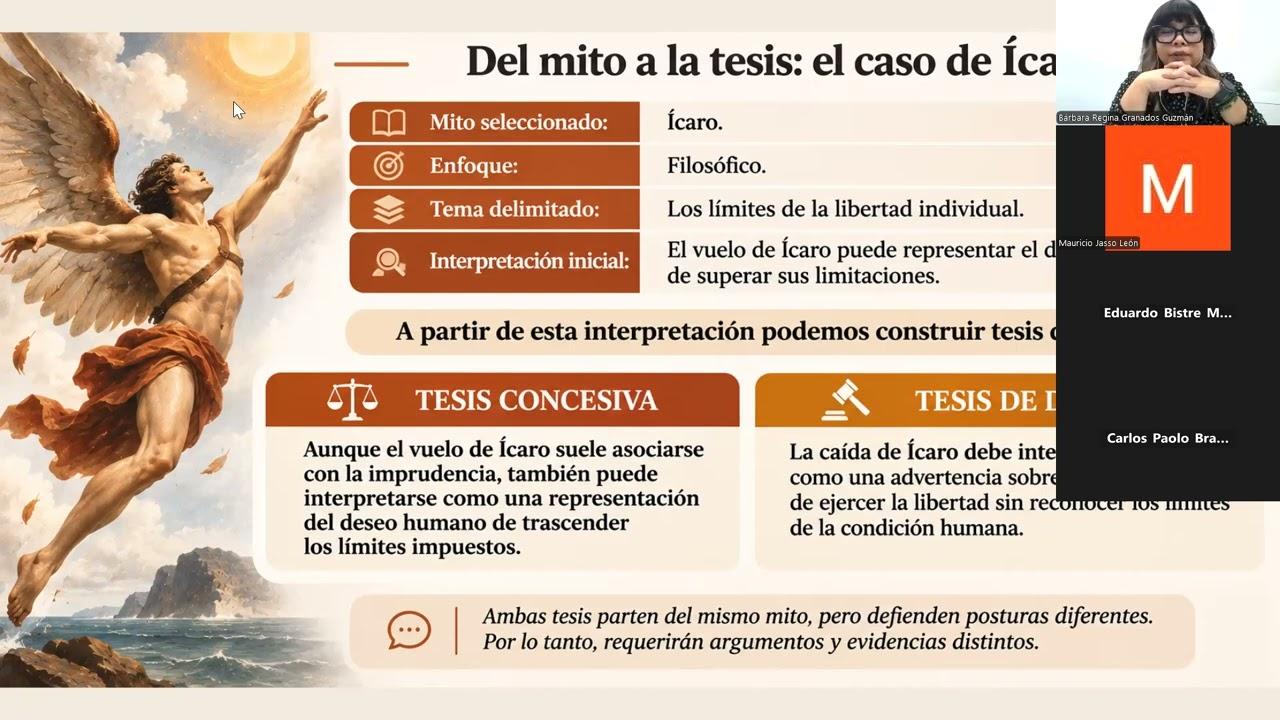
Today we have a very important, very complex, but cool, very interesting topic. So, let 's review it without further delay to get to the explanation and complete the exercise we have for today, which will undoubtedly be interesting. I hope you find it interesting. And well, here we go. Today we will be reviewing the concept of Ibris in mythology. This concept of Ibris, in how it is transmitted and how it is drawn within the Greek methodology, will give us a kind of mold, a kind of direction, so that it allows us to identify almost like the archetypes. Do you remember that archetypes were these molds that were filled with experience, that were combined with different things? Well, Ibris is part of a cycle known as the cycle of Greek tragedy. And precisely this, let's say, in which the Greek works, the great speeches, the great stories of this era are being built and configured in their creation. In other words, we're talking about getting closer to analyzing, to blurring how these great tragedies and these great original works that give life to modern stories, or that we encounter again and again and witness as they are reinterpreted time and time again, come out, right? So, that's why today's topic is so important because it will allow us to understand not only the mythological structure, but also the overall narrative structure of this Greek school, right? So, here's a quick overview. Greek tradition is permeated with stories that warn time and again about the consequences of excessive pride, excess, and the violence that arises when man forgets his limits and sets out to challenge the order of the world. This is the basic idea , right? If we look at different works from the tradition of Greek culture, we will find this pattern where once man surpasses or dares to question the divine order or authority, it has an excessive consequence, right? Uh, why? Because for the Greeks, this is the order of the world. Do you remember that in previous classes we saw the topic of worldview, which spoke to us and explained how different cultures throughout time explain order, nature, and deities? So, for the Greeks, the divine order established by the gods was immutable and very important, right? And precisely the great works of this Greek tradition are not based on a mere succession of events, are they? But rather keywords that condense the core of the stories, right? For example, hubris or catharsis, right? They are simply part of a vocabulary that we might hear in a literary analysis, a critique, a paper, or an academic essay; they are not specifically categories that the Greeks used to distinguish their stories. Uh-huh. These are precisely the formulas that structure, or rather the axes upon which the meaning of the works is built. That is, this means that understanding what the concept of hydris means, for example, is in general or to summarize, understanding what is at stake each time that, in the tragic scene, the human being faces his destiny. Uh-huh. So, what elements do we have so far that frame the ibris? Well, it's a formula that's found within the tradition, which are terms that conceptualize a chain of events internally. Uh-huh . So far we have the building, right? It's like a categorization, but is that all it is, or does the concept have more to it? And since we're talking about the Greeks, well, of course, of course it has more complexity, right? So, within the same context, I'm going to ask you to do the exercise of separating our conception of good and evil, which is undoubtedly influenced by the Judeo-Christian tradition in general, because this is what has largely shaped our society. We have a well-defined idea of moral sin, don't we? Deeply rooted in our modern society, in our current society. So it's going to be important that to understand this concept we detach ourselves from that idea and understand that the Greeks didn't understand the world as good or bad, right? But rather as a transgression inscribed in the cosmic order. In other words, you committed a bad act when you dared to step out of line with what the gods, the cosmos, divinity, and the world had delineated for you. So, when you step outside that framework, then you are transgressing that divine order, right? And precisely the Greeks had a concept called Moira. The moera was therefore exactly like this conception of the world, wasn't it? What each person had to do in every thing in the world. So, if you look closely, these are like ways of breaking down this thought, right? And precisely to understand this concept of Greek tragedy, so very famous, that I don't know if you have ever heard of it, or if someone says that, oh, this is not a Greek tragedy, relax. Well, because Greek tragedies tend to be true tragedies. So, to truly understand this position, this, as I say, forgetting about the concept of sin, because we're not talking about a line of good and evil, but about messing with the balance of the universe. So, for the Greeks, the universe already had a pre-established order. In other words, you are born and every human being, animal or God, this is quite interesting, isn't it? It only applies to humans in the sense of people, right? Uh, it applies to all living beings that inhabit this world, that inhabit this earth. So, each and every one of these beings already has an established order, they already have a line drawn out for what their life will be, what they will do, what they will not do, what difficult aspects they will face, right? And this means that each of these beings and each of these people has a place and a portion of the world, a portion of the universe, right? So that portion of the universe is Moira. Death, death is destiny, what is your lot, what is written on that life line for you. And to be in harmony, uh, within the Greek slang, means to accept that destiny, to accept it as it is written, without questioning it, simply because it was chosen for you and it is what you have to go through in this world. So, this is very important because to understand hubris we have to understand this Greek worldview where you are born with a predetermined destiny. That predetermined destiny is part of a divine cosmic order, and if you deviate from that destiny, well, that's where problems arise and emerge, right? Any questions so far? I understand that it may be too early to suddenly start talking about concepts, but it's important to put it into practice. Go ahead, Pablo. So, we could say that hybridity is more like a set of elements that show you that something is being transgressed, and more than an idea it's like a classification, right? Right now we're going to see it's part of a century, I mean, to avoid saying a, I mean, to give a very harsh example, we can say that when someone, for the Greeks, when someone committed something that went outside the natural order, outside the order of Moira, they would say that it was hubris, right? Uh-huh . You are falling into the hydris. Uh-huh. Okay. Okay. Imagine it as falling into, not into, the dark force. Not as a look, but yes, be driven by your own desires and interests to the point that you dare to question the life you were given, right? Gonzalo, go ahead . But what it means is that it is already predestined, or what it means is that in the Greek world what is going to happen in your life is already predestined by fate, that is, it is already defined what you are going to do and how you should live your life. And falling into hydris is precisely questioning that destiny and behaving in a way that is not appropriate for what you are supposed to experience. Uh-huh . There, because if it's supposed to be predestined, the Greek gods punished people like, I don't know, like this or things like that. Very good. I love that thought because that's exactly where we're going to explain things, right? Here we have the cycle of Greek tragedy, right? Well, in general this cycle is a dramatic and mythical structure centered on the fall and a noble hero who, due to his tragic mistake and the inescapable design of destiny, well, it happens in those situations, right? So we begin with hubris. Hubris is, as such, the pride or extraordinary success that leads the individual to believe himself above common laws. In other words, if the order of the world is governed by a cosmic order dictated by the gods, then anyone who believes they have the courage or the right to question it is attributing to that person feeling superior to questioning this divine dictate of not following the directive that was imposed on them in their life, right? Then comes the Old Testament, which is spiritual blindness. Specifically, it is interpreted as the pride that distorts judgment, the character's lack of prudence . So, these two, one and two, the free and the AD, are always intimately linked. When we examine this as a concept, you'll see that it's like a duality, right? Because one is part of the other. Idris is supposed to be like the action, that is, what triggers it, what gets done, but the AD is what justifies that decision to break the mold or to start questioning. So, once we have these two points, then, of course, comes an act, right? In one and two it is an individual action, the action of the subject. Uh-huh. who decides to transgress the order and break the mold to begin questioning. Uh-huh. And then comes number three and number four. The number three is nemesis, which is divine intervention or the corrective force of the cosmos to restore the lost balance. Uh, what's the lost balance? This person who is stepping away from the world and starting to do things that are not within their divine order, that is transgressing the divine order. So, a divine intervention—what does that sound like to you ? You have the answer there, Gonzalo, in your question. It is a punishment from the gods. Exactly. Nemesis is a punishment from the gods. That? to that challenging behavior, right? And then we have tuberculosis, which is a catastrophe and exemplary punishment, the definitive and ultimate fall that will generate pain and catharsis. In other words, this is where, in the discourse, in the Greek tragedy, we see the moral, where the punishment is so strong and the protagonist suffers so much that we understand that we should not challenge the divine order because we may end up falling into this punishment. Now that we see these two quadrants, which is the Greek tragic cycle, does any story come to mind? Let's see, Pablo, modern or old. Well, we can just hang out there. We just saw it very recently in class, a couple of classes ago, I mean, yes, the one about Prometheus. Uh-huh . How would we explain Prometheus in this quadrant, that is, in this process, in this cycle? Well, basically, his pride and his, how to say it, his pride to defy Zeus, who is the supreme God, caused him to have a spiritual awakening by doing an action that was like giving fire. Mm. After that, divine intervention came, which was a punishment for humans so that they too would experience hunger, so that they would hoard things. Yes, you have something, but we also gave you a curse. And in the end they punish Prometheus by making some withers eat his instants every day. His liver. Mm. His liver. Yes. Very well, thank you very much, Pablo. Isaac, go ahead. Isaac, we hear you. Oh, sorry, I'm mutated. Yes, the myth of Icarus kept coming to mind. This one, I feel like, well, yes, I mean, it represents too much pride that he was warned not to fly so close to the sun and well, the castle and he didn't care. Uh-huh . Yes, Icarus is precisely one of the examples that most closely resembles Prometheus to Icarus. They are like these stories that are used to explain this cycle of Greek tragedy. Go ahead, Gonzalo. Very good observation. Well, I think that, as I mentioned earlier, Siifo was punished, and what he did was precisely to his own benefit, to deceive the gods, and he deceived them several times. So I think it's very literal because Prometheus's act was heroic, but yes, it was for the love of life. And you know, that's very appropriate, very relevant, Gonzalo, because precisely in one of the examples I selected to understand this Greek tragedy, because it's easy to identify it when it's through a heroic act, right? It even has a justification, however illogical. But when we transfer this to a story where the objective is not to pursue something good or to provide, in the case of Prometheus, to provide man with the wisdom of knowledge and the opportunity to develop it in society, what happens when the motivations are completely and absolutely personal? No? So, the punishment is deserved, that is, the nemesis and the consumption are appropriate, right? Because if we think about it in terms of the concept of Prometheus, it might even be unfair, right? Because the goal he pursued was a noble goal, a just goal, but when it is not so, then the meaning of this narrative changes a little. I mean, I don't know if it can fit in here, but maybe it's literally the odyssey because in Ibri it would be like the pride of, well, literally, of Odysseus, that he knew another, faster way and so on, and then also when he blinds the Cyclops and well, that's when they start punishing him, right? And so. Exact. And they tell him, in fact, one of his companions mentions to him that, hey, don't tempt the gods. I mean, in the end he's the son of a god, so you're not going to make him angry because there was no need to do that act of hurting him, right? And right, very good, Melis, it's a very good example. And how wonderful that we can identify this because in the end the Odyssey is indeed a Greek tragedy, it's a story with all these hallmarks, but also I don't know if you felt that the film gives us a certain sense of also watching a modern story, I mean, yes you're seeing a reflection of the classical story, but it also feels like watching a current film, right? Because? Because we have seen the narrative framework many times, so that gives us that familiarity. Uh-huh. Sofia, go ahead, I'm listening. I do n't know if it applies well because of the Nemesis theme, but I was thinking of King Midas because he already had what he had, he had a lot of money and yet he still asks that everything he touches turns to gold. So, he is very blinded by greed and doesn't think about all the consequences of his actions. So the nemesis is not so much divine. That's why it does n't apply, because it's more a result of his own pride and it's a curse he brings upon himself. But the thing is, he even turns his daughter into gold and she has to go and beg them to take away the gift, and I think she can't even eat because everything turns to gold, but I don't know if the nemesis applies. Centric because it's like it's built on a metaphor, right? In the end, the nemesis doesn't necessarily always have to be an angry god, the one who commands the action or the punishment. When we translate this cycle into a narrative, this nemesis can be the same counterpart of the person who generates this action, that is, the same lesson that their actions make them face and oppose. In this case of the king, it is right to realize that what he conceived as blinded by his greed and his desire to enrich himself and surround himself with gold, is precisely what is leading him to his own tragedy, what is leading him to his own punishment. So, we also have this duality many times in the cycle of Greek tragedy, where what seems like the reward becomes the punishment. When you take that centralization away from that individualistic idea of greed and only seeking personal gain, when you release that gift into the world, you realize that it's not actually something beneficial, right? Rather, it has consequences that the protagonist or the person who started doing that action did not mention. Because? Because he was spiritually blind. That's why the concept of Ibris and the concept of AD are so closely linked, right? Just as DNSIS is also linked because it's like a kind of punishment, it's like a cycle, it's a pretty well-defined cycle. Hey Pablo, go ahead, do you want to comment on this topic? Ah, well, one, I mean, I was going to say something about the odyssey, but I don't know if it's related to the topic, to be honest. Forward. Ah, well, Christopher Noland's adaptation of the Odyssey also reflects us, well, I've always said that it's a modernization of the Greek tale, we could even say that it's more of an American modernization , it maintains the elements of tragedy, the elements of adventure, of epics, but they are done in a more modern tone, I mean, to a certain extent, Greek tragedy and current tragedy are not similar. They look alike , but at the same time they don't . On the one hand, well, the punishment of the gods to Odysseus in the Greek story, you know? Mm. It's more like it's not so much, it's more divine, you know? In other words, it's more direct, whereas the greatest punishment that Odysseus has in Christopher Nolan's film The Odyssey is more personal, more about himself, more symbolic. Yes, more symbolic. Fair. Hey, it's a modern interpretation of history. In fact, there were questions like, " Why spend so much time going over arcs that have already been covered in other stories?" Or why not focus or delve deeper into the world of tragedy, or into the portrayal of the characters, or into everything surrounding the story of the odyssey beyond Odysseus? So, this little scheme we have here will be reflected in a wide variety of examples. Okay, but before that, let's watch a video with lots of content, guys. So, we have to pay attention. Let's look at some concepts, let's look at an example. Then, very important for our class, Greek mythology tells us that Prometheus was a titan, a friend of mortals, who decided to help humanity improve their living conditions. To do this, this titan steals the fire that was in Zeus' possession, an act with which he clearly defied his imposing authority. Zeus then punishes Prometheus, ordering that he be taken to Mount Caucasus, where he is chained so that an eagle will permanently devour his liver, since being immortal, it regenerated again and again . In Sophocles' tragedy Oedipus Rex, Oedipus is a man who, despite his best intentions, ends up committing acts that defy the divine order and lead to his own destruction. Oedipus prides himself on his intelligence and believes in his ability to escape his fate, which leads him to act with overconfidence. In his attempt to discover the truth about his origin, he confronts the oracles and defies their destiny. Thus, trying to avoid the prophesied fate, Oedipus kills his father, King Laius, and later marries his own mother, the chaste queen, ignoring his royal kinship. Upon discovering the truth, Oedipus averts his sight in a symbolic act that expresses his rejection of the horrible reality that he himself has unleashed. In another mythical tale, the young Icarus disobeys the instructions of his father Daedalus. Believing he could defy the limits imposed by the gods, he flies too close to the sun on wax wings. And there is also Arachne, a talented weaver who challenges the goddess to a weaving contest. Harne thus weaves a masterpiece with which he intends to mock the gods. But Athena, furious at her audacity, plans a punishment for her and ends up transforming her into a spider. All these cases give a clear example of the meaning of hubris for Greek culture. With this word, the Greeks were referring primarily to excessive behavior, to a transgression and lack of humility before the gods, which justly attracts divine wrath and punishment. For the Greeks, it was fundamental to recognize established limits, and in that sense, exaggerated and irreverent passions were seen as illnesses. That is why they were attributed to the influence of Ate, the goddess of fate, whose name in turn means folly, deceit, fury, pride, ruin, that is, the personification of both thoughtless actions and their consequences. Thus the Greeks used to remember a famous ancient proverb that states, he whom the gods wish to destroy, they first make mad. So, in the face of all these acts, Nemesis, the goddess of vengeance and divine justice, invariably makes her appearance; she has the responsibility to punish hubris, restoring balance and proportion. Not for nothing did Apollo, from his Dephidian temple, imperiously prescribe, "Know thyself, in particular your limits, and nothing in excess, that is, the complete opposite of hubris." Such commandments spread from the high mountains of Delphi to all of Greece, and ethical conceptions such as those of Socrates, Plato, Aristotle, Democritus, the Stoics, and Epicureans conformed completely to such commandments. For Aristotle, the intellect, the divine spark in man, is capable of controlling his own person and therefore it depends on each one to maintain sophrocine, moderation, serenity, achieving autarchy, that is, self-control. Aristotle mentions Sophro-Cinema in several of his works, but mainly in his Nicomachean Ethics. In his ethics, Aristotle discusses the concept of virtue and points out that it lies at the midpoint between the extremes of vices, one of deficiency and one of excess. On the other hand, in his poetic work, Aristotle mainly addresses Greek tragedy and its structure. And while it does not focus directly on hubris, it does mention some important concepts related to it. Thus it says, in tragedy, one of the features that generates empathy is the hamart, which translates as fatal error or tragic failure, a morally wrong action that leads to the misfortune of the protagonist. Therefore, for Aristotle, tragedy has the invaluable ability to provoke catharsis, that is, the purification that occurs in the spectator when confronting his own base passions, which allows him to appreciate the deserved inevitable punishment of these, although without experiencing it himself. written by Euripides. The tragedy Medea has been paradigmatically related to the Ibris. Medea is a foreign woman and a powerful sorceress. She falls in love with the Greek hero Jason, whom she helps in his search for the golden beauty. Once that episode was over, they got married. However, when Jason decides to abandon her to marry Princess Glause for convenience, Medea feels betrayed and suffers deep humiliation. Medea's Jubris is manifested in her response to this betrayal. Pretending to accept the scorn and seek reconciliation, Medea chooses to take revenge and display her full power. He uses his knowledge of magic and his cunning to devise a cruel and bloody plan to punish Jon and his new wife. In this act of revenge, Medea commits atrocious crimes, including the murder of her own children, whom she had conceived with Jason. in order to inflict maximum pain on him. In her anger, she is willing to violate the most sacred taboos, such as maternal love, in her quest for revenge. Perhaps for this reason, to curb Nemesis, the punishment deserved for Hubris, in ancient Rome, when a general paraded victoriously through the streets of the city, behind him a servant was in charge of reminding him of the limitations of human nature, continually telling him, "Memento mori". Memento mori is a Latin phrase that translates as remember that you are mortal, remember that you will die. The aim was to provoke reflection on the transience of existence, reminding people of the danger of falling into excessive pride and arrogance. No one, least of all the powerful, should feel exempt from the limitations and vulnerabilities of the condition. human. As you can see, this scheme, in addition to the examples we saw, we see it in a direct way and also in a conceptual way, right? They were able to recognize or think of examples or perhaps identify this framework in some other stories. Did this video make sense to you in relation to what we just saw ? The intention is precisely that we see that these concepts are not just focused on stories, you know? This concept of tragedy is so profoundly important to the Greeks that we see it in philosophy, we see it in the great stories of these great thinkers who are references for ethical issues, for philosophical issues, for frameworks that still guide us from philosophy through good and evil, right? Aristotle's concept of virtue , the mean, is still widely used in philosophical dissertations. So, it goes all the way there , to that very core of thought lies the concept of irris, the concept of transgressing the magical order. So, isn't it wonderful to recognize this idea of natural order, of cosmic order, in civilizations and thinkers who are centuries and centuries removed from us? and to see how those same frameworks still take root in our thinking. Now we're going to move on to a definition that will be important for the task we have for this week, because it's necessary to outline the boundaries of this concept, right? Hubris itself isn't bad behavior, is it? Either to be bad or to be a bad person in the current sense. That's why I'm telling you that it was very important to move away from the concept of sin that we have today. Uh, ibris is to go overboard, that is, to go out of line. It's not about going beyond your own limits for the first time. Secondly in the background, let's say, we would have that it is the error of the mortal who forgets that he is mortal, right? And it intends to act like a god occupying a place in nature. or in the cosmos that was not granted to him, that is, that he is not in his destiny or in his cosmic line of the cosmic order, of the magical order. Those who commit isdris do not do so out of conscious malice, but because they have lost sight of reality. Remember that I mentioned that Idris and AD are always linked because Idris is action and AD is the spiritual blindness that the subject may have. So, here are some examples of current story concepts that you might be a little more familiar with. Someone watched Dead Note, Fullmetal Alchemist, and Attack on Titan. Attack on Titan Youngsters is my favorite anime and Eren Jaeger is my personal enemy, and I am prepared to take this debate to its ultimate conclusion. But well, Pablo, before giving you the floor, let's look at these examples, let's bring them down to earth a little. If you look at the first villain we have, Light in Death Note, what he does is precisely believe that he can have this divine order, and at some point in his process of this spiritual blindness, he believes that he is a God and believes that he has the infinite power to manipulate and, through this gift or this power or this advantage, to build a new order, a new way, a new universe, and let's say that it is specifically linked to what he wants, to an individual, personal motivation for power. But then we have this second example of Edward Elr, who has a motivation, yes, a personal one, but it's a motivation that comes from love, right?, which is to bring his dead mother back to life through this knowledge he has of alchemy and magic. So, here we see a direct punishment that is precisely his nemesis, which is losing part of his body and losing the total corporeality of his brother. Uh, why? Because of this challenge of trying to break that natural order which is death, right? In other words, how can a human being, even if they have a living being, even if they have the capacity and the knowledge, dare to challenge the primordial order of things, which is the order of life, that every living being has the only thing that is certain in this world is that it will die? So, when trying to break that line, there is no greater questioning of the divine order than trying to bring back someone who has already crossed over, who has already left that plane, whose destiny was to die due to circumstances or a certain age, and trying to break that line is definitely a major questioning. And then we have Eren, who in his excessive desire for freedom and to change the order of things through the trauma of having seen a titan devour his mother, well, he drives total destruction seeing himself as the judge and only finding in his motivation and his point of view the only truth and the only way to reach what he considered the world should be, right? Does anyone know these examples? Pablo, go ahead with your comment. Next, we'll go to André. I have two. I'm going to start with one, an example like an example that occurred to me. Mm. The truth is, you're like, it's very, like, it 's strange. Well, the whole point of that is that, yeah, Creatod is literally a tragedy. The story of Crat is literally a Greek tragedy. A Spartan who, thanks to his actions in the war, the gods were interested in him and, in order to keep him as a weapon, they basically made him kill his family, and that caused him extremely high anger, making him want to kill all the gods in the end. And I would say it's like a Greek anti-tragedy because in the end he succeeds, you know? In the end, he manages to achieve his goal, but he realizes all the chaos and destruction he caused in the world. So, he doesn't do it for the punishment, because there is no punishment anymore; he does it of his own free will. But that self-reflection is perhaps not intended as a punishment as such, but that self-realization of realizing that what you did may not have been the best day, well, it's a bit of self-discovery and self-criticism. That's where the nemesis might come. This example is very important, Pablo, because it shows us that the application of the cycle of Greek tragedy can never be literal, but can be metaphorical, right? Yes. And this very introspection is also the realization of the punishment. What is worse for a hero than realizing that their actions caused the exact opposite, caused pain, caused suffering when you want to achieve something that you ideologically believe will be positive for you, for your environment, for your family, for whatever your motivation may be, and then realizing that perhaps it wasn't the best path or the most direct path? It's that kind of loss of spiritual blindness and returning to reality and realizing what your actions caused or what your actions transformed in the world. It's a part of self-criticism that can become the nemesis of the hero himself. So, the nemesis won't always come as an exemplary punishment or as a very literal or very clear, very specific divine will. Sometimes, personal self-realizations, concepts, or moral lessons that arise within the story can come through these self-realizations. Very well, thank you very much, Pablo. Andrea, go ahead . Yes. Um, well, I think that, like you mentioned, Light's castle also ended up killing a lot of people who, well, we know that many times many people are wrongly convicted. So, apart from being a punishment, when he dies, his punishment is that he no longer goes to heaven or hell, he returns to being, well, nothing, he doesn't cease to exist. And I think, I mean, I would consider that as such an intervention. Uh-huh . In history, this consequence is precisely divine punishment, isn't it? Because it's not something that happens when a person who didn't transgress dies, right? I mean, it's something special that only happens to our villain, our protagonist in this case. So, it's exactly as Pablo was telling you, an example of how this cycle and these representations of desenesis and tisis and antiilais can become metaphorical, right? They will always have. In some stories we do see the patterns very well defined, but in others at other times we see how those things kind of become blurred and precisely we find these ideas of questioning. Now we're going to get into the perspective we'll need for you to do this week's homework . What if that transgression of Idris is what humanity needs to progress? No, for the Greeks, Prometheus committed an unforgivable transgression by stealing fire from the gods, which represented technical knowledge, to give it to men. His punishment was an eternal example. The Greeks viewed fire with suspicion. Technology could be capable of disrupting the cosmos, disrupting that divine order that was believed to exist in the universe and the things that happened within it. But from the Enlightenment and the Industrial Revolution onwards, the Enlightenment being understood as a historical process where there was a change in thinking and a change of vision within humanity linked to the Industrial Revolution, which we know is the industrial development and what it is based on is industry, especially in this era in the 16th and 19th centuries, producing, producing in machines, in fire. And for all that, you need precisely that spark that was given by Prometheus, right? So, in this context of the Enlightenment and the Industrial Revolution, Prometheus becomes a hero of humanity because he steals the secret of fire to give it to humans, and with that, humans were able to achieve the progress we have now. Then you begin to see this dichotomy where Prometheus, by giving the gift of fire to men, gives us the possibility of progress. Then there begins to be an analysis of whether falling into Idris is really bad in all cases. In other words, when you dare to question and dare to break the mold, well, that's not an attitude we often see in our heroes, in the stories we know, is it? This desire to question is natural and inherent to humans, is n't it? So, that's precisely where the debate is headed. We're going to watch a video that lasts about 5 minutes, that will give us plenty of time to watch it. I have a very illustrative example from Faust. Has anyone heard of Faust? Well , today we're going to look at a rather interesting perspective that will allow us to shed light on this topic. The Faust myth is one of the most fascinating stories in German culture, laden with philosophical, moral, and existential meanings. Broadly speaking, it is the story of a man who, dissatisfied with the limits of human knowledge and his own life, decides to make a pact with the devil to obtain unlimited power and wisdom in exchange for his soul. But this myth has been told and retold in multiple versions, the best known being those of Christopher Marlow and Johan Vong Gute. But how did this myth originate? The character of Faust is inspired by the historical figure of Johan Georg Faust, a German alchemist and magician who lived in the 15th century, more precisely between the years 1491 and 1541, when he died due to the explosion of one of his alchemical experiments. Faust was a controversial figure and was said to practice black magic. His life was shrouded in mystery and legend, which eventually made him the protagonist of a mythical story about ambition, forbidden knowledge, and the damnation of the soul. In fact, pamphlets were published and distributed throughout the Holy Roman Empire about the myth of Doctor Faustus. Over time, the line between the real Faust and the myth became blurred, and establishing real facts about the person is a challenge. In fact, in the 10th century, the existence of a historical Faust was even doubted and was mixed up with the image of Johan Faust, one of the first printers, born in Mauncy and partner of Gutenberg, the creator of Western printing. Although the best known and most complete version of the Faust myth is that of Gut, published in two parts in 1808 and 1832, the first major adaptation was that of the English writer Christopher Marlow in 1592, considered the great predecessor of William Shakespeare in his theatrical work of Tragical History of Dr. Faustus. Both versions follow a similar thread, although they have significant differences in their messages and outcomes. The plot begins with Faust, a scholar who has reached the limits of what human studies can offer him and is disillusioned by the inability of science, philosophy, and religion to give him satisfactory answers about the meaning of life and the universe. Faust decides to resort to magic. summons Mephistopheles, a demon who acts on behalf of Lucifer, the devil. Mephistopheles offers him a deal. Faust will be able to access all the knowledge and pleasures he desires for a time, but in return he must give his soul to the devil when the pact ends. In Marlow's version, Faust uses his newfound powers to experience a life of excess and pleasure. Travel the world, meet historical and mythological figures, and revel in their ability to defy the laws of nature. However, he soon begins to realize that, despite his powers, he still feels unsatisfied. Throughout the play, Faust experiences moments of regret, but finally, when the time comes to fulfill his part of the bargain, he is taken to hell, eternally condemned for his excessive ambition . Whereas in Gute's work he introduces a more philosophical and complex dimension to the myth. In Gut's Faust, the protagonist is not a mere pleasure seeker, but someone who seeks meaning in existence itself. Instead of focusing on moralistic condemnation, Gut explores themes such as human dissatisfaction, the duality between good and evil, and the constant yearning to transcend the limits of the human condition. In this version, Mephistopheles represents the cynical and dark side of the universe, the one that questions the value of human life and the power of good. Faust, through his pact, becomes a man who seeks a deeper form of fulfillment. Unlike Marlow's version, Faust's ending is more hopeful. At the end of his life, Faust realizes that his true desire was not simply knowledge or power, but to find a purpose in creating something that benefits others. In the final moments, when he is about to die, the angels intervene and save him, taking him to heaven in recognition of his effort to seek a greater good. The Faust myth explores a series of universal themes that have resonated throughout the centuries. First of all, the theme of unbridled ambition is central. Faust symbolizes human nature in its constant search to achieve something beyond what life offers. His pact with the devil is a metaphor for the dangers of the desire for unlimited power and the disregard for the consequences. Another key theme is the duality between good and evil. Mephistopheles is not simply a villain; he is a more complex figure who tests Faust's faith in the goodness and purpose of the universe. In Gut's version, Mephistopheles claims that his role is to tempt humans to fail, but often his temptations lead people to discover deeper truths about themselves. The myth also deals with redemption, while Marlow's version leans towards a non-pessimistic view where Faust is inevitably condemned by his pride, Gut offers a more optimistic version and perspective . In Gut's Faust, redemption is possible even for those who have made serious mistakes, as long as they sincerely seek good and strive to improve. The Faust myth is a rich and multifaceted story. Throughout the centuries, this legend has been reinterpreted in various ways, such as Lits's Faust Symphony or Richard Wagner's Faust Overture, and in film with movies like Murn's Faust from 1926, who also directed Nosferatu or George Melier's The Damnation of Faust from 1903. Even so, its essence remains intact. The dilemma between the desire for power and the price we are willing to pay for it. Ultimately, Faust is a metaphor for the human spirit, always unsatisfied, always searching for something more, and always facing the consequences of its decisions. I hope you enjoyed this video. Don't forget to subscribe, it helps me out. This video shows how interesting it is that there is a point in the story where the perspective changes. So, Faust, in his quest for knowledge beyond human possibility, becomes a hero instead of someone who should be judged and questioned, right? So, this change in narrative perspective that Gel gives us is precisely a representation of how the human mind, and well, people's perspectives, change as we enter a modern spirit, a more current spirit, a spirit of seeking knowledge, of always going beyond the limit, right? So, that's precisely where our conclusion leads, to understand the exercise we have for this week, right? Today we live in the ultimate expression of Ibris with advances such as artificial intelligence, genetic engineering, climate engineering and all these aspects that I don't know if perhaps you have heard some speech from some religious fanatic where he tells us that what we are doing is causing our own end. The day of judgment is coming, and all these speeches that suddenly seem alarmist, exaggerated, and dramatic to us today... Imagine that he is a Greek who traveled the world and is now surprised by all the progress, because this will be part of the cosmic order that the gods say for us. In other words, the knowledge that we develop day by day through science is permitted to us by a natural order. Is there a God who truly wants this to happen the way it's happening? No? So, those questions become blurred in thought and in the social importance that humanity itself, that is, we as humans and as part of a society, determine and define what is important, what we value, that is, what has more weight, the ideology of morality or the progress of science, right? So, each era weighs things up, and based on that, development and evolution are built, right? So, with this thought and this question in mind, that's precisely how we arrive, that is, if we return to the topic of lais, let's remember that it's not necessary to start thinking about who is right or where what is just is , but to do the conceptual exercise. Just as a parenthesis. I don't think I want them to think that I believe artificial intelligence will lead us down the path of perdition and that it will punish us. No not at all. That is a conceptual framework. Precisely to progress, humanity ignores the human condition and plays towards God, which here is like having the ibris. And that same impulse generates a new blindness in us, making us believe that technology can solve everything infinitely, and we become incapable of seeing the catastrophic risks we generate with the climate crisis or the technological existential danger. The Greeks were right that hubris overflows and breaks the order, but history has shown that without that dose of excess and humanity's daring to always question, we would have remained stagnant. Therefore, human progress is by definition a continuous transgression of our limits. Uh-huh. So, with this idea in mind, with this context in mind, let's look at the activity we have for this week. Uh, let me go to modules and open what we have to work on. Look, right now we're only going to have time to explain these activities. First we have this one and then this one. Very good. The first thing is an activity that, while it does not count towards the final grade, will help you with the collaborative activity that does have a percentage value. So, what we're going to do here is watch the movie Prometeo Rally Scope. Has anyone seen her? If someone has seen it, then maybe they can generate the exercise directly. And if someone hasn't seen it, it's not a period of time at all, you know? I mean, the movie is awesome, it's good science fiction and it involves a lot, you know, it's called Prometheus, right? Just imagine where the director is going to take the central analogy of the story , right? So, it's going to have a lot to do with what we've seen now about the limits of knowledge, the limits of divine action, the questioning of the divine order, and all of that in an alien-like plot, right? It is considered the prequel to the prequels of the Alien movies. So, it's cool , I liked it quite a lot. And then we have here a small quiz which is exactly 10 questions. Regarding the Prometheus movie, I'm just doing a knowledge check. And then we'll move on to the collaborative activity where you, in collaboration with your teammates, will make a video about Ibris, right? First, do some research, choose at least two myths that illustrate the concept of Iprens, for example, Icarus, Dalop, Prometheus, which were examples widely mentioned by yourselves. So that's something I really like about this class, isn't it? Because of the name itself, there's always a certain affinity between students and the topics. So, we never start from scratch, and that's wonderful. And then some modern literature, right? Let's select two contemporary literary works or films that address the theme of rebellion against established rules, shall we? Here we understand rebellion as transgression and rules as divine order. Ah, always remembering this little picture from the Greek tragedy cycle that we just saw today, right? For example, Franken State or Blade Runner. And there are some others that you can also select. Create a script that includes an introduction, the selected candidates, your analysis, and your conclusions so that you can read it more effectively and then edit the video. They can't use tools like, well, the ones that come here, but it can also be done in Canva. The truth is that with Canva you have some really nice examples for videos, including images and clips from the movie Prometheus, right? So that it refers to us. Remember that this film will be like the central axis of the exercise or the discursive line that will lead to some examples and a maximum of 5 minutes and you hand this in to Campos. This is for Sunday. Uh-huh. So, uh, right now in the last few minutes of class, what we're going to do is open rooms so you can get together with your teams and touch base. I'm going to set up six breakout booms for each of you to choose from, that is , as you self-enroll, that is, enter, choose which one to enter and the breakout room number is the same as your team number. If anyone doesn't know which device they're on , that's why I have them open here so you can check. Okay, the idea is that they use that time to get on the same page because, well, I heard that some teams had communication problems, so it's important to address that issue. Uh-huh. Then I'm going to open the break rooms. There will be six. We're going to spend 5 minutes in the Breakup room and then I'm going to close the session. Return here to plenary. Anyone who has a question or wants to comment in general is welcome, but if not, after this talk with your teams you can leave. Okay, I'll leave it manual. Great, they should already appear there in the menu you have in Zoom, click on the three dots where it says breakout rooms and then select the room number that corresponds to your team. Okay, the tasks aren't in modules yet, right? Uh, no, let me post them right away. Yes, please. Thank you. Okay, that's it, they're published now. Does anyone have any doubt about which team they want help finding out the number? Roberto, Diana, Andrea, Ra, Eduardo, Isabeli, I 'm already looking for it, thank you. Yes, perfect. Teacher, tell me. I can tell you something right now. Everyone to the groups. Of course . I asked a question. I didn't quite understand the part about groups. Oh, are you going to choose to add yourself to the breakout room number that has the team number you're on? Which team are you on? It's true. Is it the same one as last time or? Yes. Let's see. Okay. I mean, you're at number two. In the second one. So, I mean, it should appear for me right now during the session . There you are. You should see the invitation. Aranza. Yes. Do you know which team you're being analyzed for? In the third. Let me. Ready.